
Turning Your Kid's Drawing Into Something You Actually Wear: What to Know First

We were in Portland a few weeks ago, a city so creative that even the trash cans are painted, when a stranger stopped my husband to ask about his sneakers.
He didn't just say thanks and keep walking. He pulled out his phone and showed them pixyit.com, because those sneakers came from our son's own drawing, printed on the pair he wears every single day.
And of all places, in a city where art is on every corner, the thing that made someone stop was a drawing by a 10-year-old.
This happens to us constantly, and our kids are usually standing right there when it does. Big smile, pure pride, every time. I've come to think that moment matters more than the product itself. A drawing on the fridge gets seen by the people who already love your kid. A drawing on a pair of sneakers gets seen by people who have no reason to care, and sometimes they care anyway.
If you've been thinking about turning your own child's artwork into something real, here's what we've learned, both from doing it for our own family and from making these for hundreds of other families.
Pick the drawing with the most personality, not the most skill

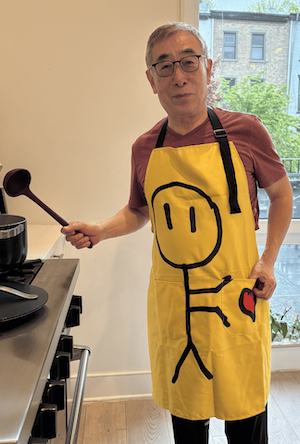
The instinct is to pick the drawing you think is the "best". Resist it.
The drawings that make strangers stop and ask are almost never the technically impressive ones. They're the ones with an odd, specific idea behind them. Our son's most-noticed drawings are a cat that spits, a giraffe that appears to be judging you, and something called a chili tiger. None of those were his most careful work. They were just the most him.
Don't worry too much about whether a drawing is "print-ready". Light pencil lines, a busy background, a photo taken in bad kitchen lighting, those are all things that can be fixed on our end. We thicken faint lines where it helps, remove backgrounds when a piece needs to stand alone, and adjust lighting so the colors pop the way they do in real life. Every design gets looked at carefully before anything is printed.
Pick the one with the story. We'll handle the rest.
The one thing we can't fix: a crooked photo
There's exactly one part of this that's on you, and it's worth thirty seconds of care.
If the artwork is photographed at an angle, it will print at that angle. We can brighten a dark photo and clean up faint lines, but a skewed perspective can't be undone without distorting the drawing itself. So if the paper looks tilted or stretched in your photo, that's how it'll look on the shirt.
Getting it right is simple:
Hold your phone flat and parallel to the paper, directly above it, not leaning in from the side.
Center the artwork in the frame with a little margin around all four edges.
Flatten the paper first. Fold creases and curled corners change the shape of the drawing in the photo.
Step to the side of your own shadow so it isn't falling across the page.
You don't need a scanner or good lighting or a nice camera. You just need the drawing to be square to the lens.
Pick the product based on how much it'll be seen
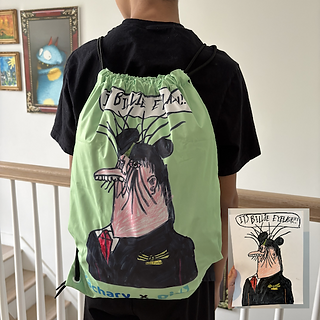

This sounds obvious, but most people choose based on what they'd personally like to own, and then the drawing lives in a closet.
If the goal is for your kid to feel proud, choose something that goes out into the world. Sneakers, tees, hats, umbrellas, tote bags. These are the ones that lead to strangers asking questions, which is the whole magic of it.
If the goal is preserving a memory, keepsakes make more sense. Blankets, framed prints, art books, mugs that live on the counter.
Both are worth doing. Just be honest with yourself about which one you're doing, because they lead to very different choices. In our house, the sneakers get noticed roughly a hundred times more than anything we hung on a wall.
Order a little earlier than feels necessary
Our trusted fulfillment partners print everything on demand, which means your item is made after you order it. Nothing sits in a warehouse waiting, and nothing gets thrown away. No inventory, no waste.
We also test every product ourselves before it goes into the shop. If it's listed, someone here has held it, worn it, or used it, and decided it was good enough to put a kid's drawing on.
The tradeoff is that it isn't next-day shipping. So if you're making something for a birthday or a holiday, order earlier than feels necessary. That's the one thing families most often wish they'd done differently.
Save the story, not just the drawing

This is the part almost everyone skips, and the part they regret later.
Your kid will explain their drawing to you, usually in the funniest, most specific way, and you will be certain you'll remember it. You won't. Six months later you'll have the drawing and no idea why the cat is spitting.
When our son explained that his cat "spits and fails school," we wrote it down. That sentence is now the reason people laugh when they see the shirt. Without it, it's just a cat.
Take ten seconds when they hand you the drawing and ask what it is, then write down or record exactly what they say. Their words, not your cleaned-up version. That's the part that becomes irreplaceable, and it's the part no photo captures on its own.
Why we built pixyit
We built pixyit because we wanted kids to feel proud of their own ideas, and to find out early that their creativity can do good in the world.
Most storage apps can hold a photo of a drawing. What they lose is everything around it: when your kid made it, where you were, why the cat is spitting, what they said when they handed it to you. That context is the actual memory. The drawing is just what's left of it.
So the gallery isn't storage. It's your family's creative history, kept in your child's own words. And the products aren't really the point either. They're the celebration, the part that takes something out of the drawer and puts it in the world where a stranger in Portland can stop and ask about it.
There are three ways families use it:
Upload your own child's artwork and choose what to put it on.
Browse the public gallery, find a drawing you love from another kid, and pick a product for it.
Shop Featured Creators, where a young creator's designs are already made and ready to order.
The child is always credited as the creator, and they earn a 3% royalty on every order featuring their work. Not a token gesture, real money into their own piggy bank. We also donate 5% to youth nonprofits, so a kid's idea ends up supporting other kids too.
Watching my son realize he'd earned money from a drawing he made at recess was better than any moment on the street. He didn't just hear that his idea mattered. He got proof.
Whatever you decide to use, whether it's us or not, do the story part. That's the piece that disappears if you don't.
Want to see what this looks like in practice? Take a look at our public gallery, or browse this season's Featured Creator.


